
【Data Analysis】Calculated Ball Possession Time for Every Player in the UCL Final. The Story of Kai Havertz’s 1-Minute-9-Second Impact and Vitinha’s 5-Minute-12-Second Dominance
- 2026.06.16
- 雑記
- android, iOS, myRoupeiro
Introduction
In a 90-minute football match, it is often said that the amount of time a single player spends in actual possession of the ball is surprisingly short.
Johan Cruyff once remarked:
“Players are in possession of the ball for an average of only three minutes. Therefore, what they do during the other 87 minutes is what matters most.”
This highlights the critical importance of “off-the-ball” movement.
The character Ego Jinpachi from the manga Blue Lock goes even further, providing a specific average value of “approximately 136 seconds (2 minutes and 16 seconds).”
Recently, I decided to record every single play involving the ball during the first and second halves of the 2026 UCL Final (PSG vs. Arsenal), a stage where the world’s best compete.
Since I had all this data, I took the logs of all 1,687 events and calculated the ball possession time for every player in seconds. And because I went to the trouble of doing that, I decided to do it for every individual player, not just the averages.
Please note: I haven’t performed any strict quality control (QC), and there are some plays based on the data collector’s (my) subjective interpretation, so please take the accuracy with a grain of salt. This is just for reference. Also, some parts of this article were generated by AI and used as-is, so please keep that in mind.
Think of this as a casual, lighthearted read. Now, let’s see what the data revealed…
1. The Premise of the Analysis: “Pure Possession Time” in 90 Minutes
Before diving into the results, let me explain the methodology.
This analysis covers the 90 minutes of regulation time (approximately 103 minutes including stoppage time), excluding extra time. Each player’s “ball possession time” was aggregated based on the following logic:
- Start of Possession: The moment a player receives a pass or recovers a loose ball.
- End of Possession: The moment a player releases a pass, takes a shot, or loses the ball to an opponent.
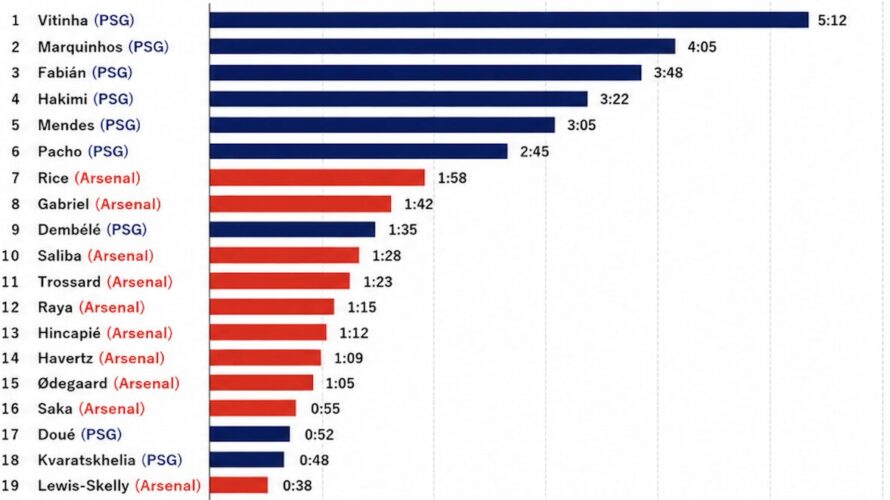
The results are summarized in the ranking below.。
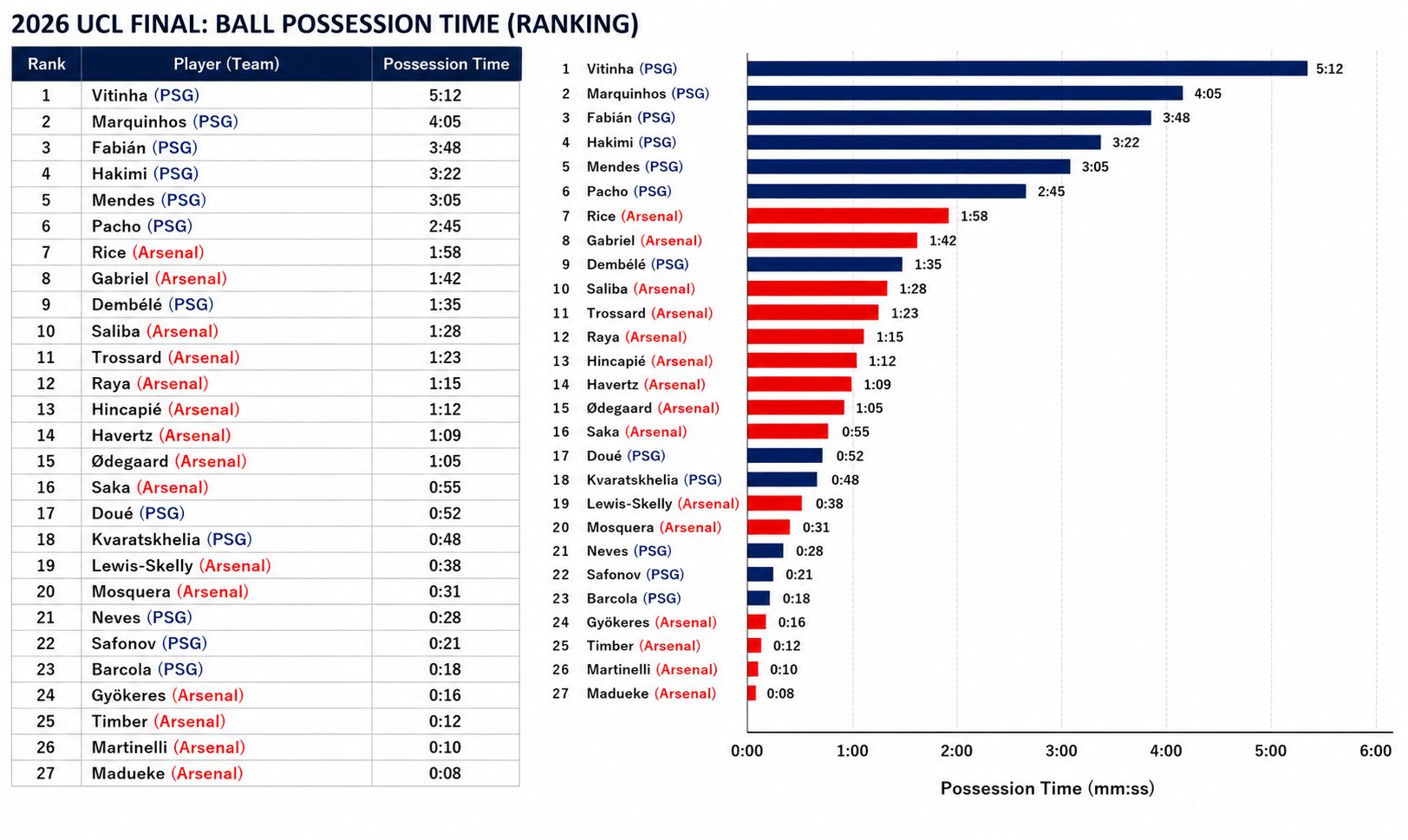
2. Ranking of Ball Possession Time for All 27 Players
Looking at the aggregated rankings, only 5 players held the ball for more than 3 minutes (all from PSG), and notably, no player from Arsenal exceeded 2 minutes. The tactical contrast between PSG’s possession-oriented style and Arsenal’s efficiency-focused approach is clearly reflected in these figures.
While this might have been expected given the flow of the match, it is still shocking to realize that in a 90-minute game, even top-tier players spend so little time actually in possession.
2026 UCL Final: Ball Possession Time Ranking by Player (The role and analysis notes were generated by AI)
| Rank | Player | Time | Analysis |
| 1 | Vitinha (PSG) | 5:12 | The King of Control. With 134 passes, he is the heart of the team and the only one to cross the 5-minute mark, literally governing the time on the pitch. |
| 2 | Marquinhos (PSG) | 4:05 | The Cornerstone of Build-up. Reflects the time spent “holding” the ball at the back. |
| 3 | Fabián (PSG) | 3:48 | The Smooth Circulator. Always finding space in midfield, he kept the ball moving to record a high possession time. |
| 4 | Hakimi (PSG) | 3:22 | The Dictator of the Right Flank. Driven by long carries, each individual possession lasted longer. |
| 5 | Mendes (PSG) | 3:05 | The Propulsive Engine on the Left. Like Hakimi, his dribbling runs put him at the top of the charts. |
| 6 | Pacho (PSG) | 2:45 | The Reliable Distributor. Focused on stable distribution from the defensive line, anchoring PSG’s possession. |
| 7 | Rice (Arsenal) | 1:58 | Arsenal’s Breakwater. The only Arsenal player nearing the 2-minute mark. The vital hub managing the transition from defense to attack. |
| 8 | Gabriel (Arsenal) | 1:42 | The Intercepting Wall. Reflects his defensive nature: quick to release the ball immediately after recovery. |
| 9 | Dembélé (PSG) | 1:35 | The Disruptive Blade. Though involved fewer times, his dribbling duration per touch kept him high in the rankings. |
| 10 | Saliba (Arsenal) | 1:28 | The Calm Executioner. Stripped away all waste, focusing on the shortest possible play to neutralize threats. |
| 11 | Trossard (Arsenal) | 1:23 | The Shadow Playmaker. A key hub that creates “time” for teammates to advance during transitions. |
| 12 | Raya (Arsenal) | 1:15 | The Starting Guardian. Functions not just as a shot-stopper, but as the origin of distribution and long kicks from back-passes. |
| 13 | Hincapié (Arsenal) | 1:12 | The Sideline Craftsman. Focused on defense while completing his role with solid distribution along the touchline. |
| 14 | Havertz (Arsenal) | 1:09 | Ultimate Efficiency. A striker betting everything on “one moment,” including his 4-second opener. He shook the world with just over a minute of involvement. |
| 15 | Ødegaard (Arsenal) | 1:05 | The One-Touch Genius. Rather than holding it, he remained a “super-fast transit point,” changing the trajectory of the ball. |
| 16 | Saka (Arsenal) | 0:55 | The Sealed Ace. Limited by tight marking, but provided constant fear that he would trigger something if given the chance. |
| 17 | Doué (PSG) | 0:52 | PSG’s Outlier. Amidst team control, he preferred quick conclusions through one-touch breakthroughs and shots. |
| 18 | Kvaratskhelia (PSG) | 0:48 | The Individual Flash. Symbolized by his penalty win in the second half, he unleashed his “individual” power to destroy defenses in a short time. |
| 19 | Lewis-Skelly (Arsenal) | 0:38 | The Young Challenger. Engaged in linking play during intense early phases, playing bravely despite limited involvement. |
| 20 | Mosquera (Arsenal) | 0:31 | The Defensive Closer. Chased by intense defensive duties, he had little room to hold the ball and settle. |
| 21 | Neves (PSG) | 0:28 | The Supply Line to Vitinha. His role was to instantly pass recovered balls to the playmaker, winning intense duels repeatedly. |
| 22 | Safonov (PSG) | 0:21 | The Silent Winner. Left the possession to his teammates, focusing more on defensive preparation than distribution. |
| 23 | Barcola (PSG) | 0:18 | The Late-Game Scramble. Used his fresh legs in limited time to help secure the victory. |
| 24 | Gyökeres (Arsenal) | 0:16 | The Power Reference Point. Ran around trying to connect a glimmer of hope through forced hold-up play. |
| 25 | Timber (Arsenal) | 0:12 | The Defensive Specialist. Focused more on containment through positioning than on possession. |
| 26 | Martinelli (Arsenal) | 0:10 | Lightning Strike – Attempted. Showed a flash of brilliance during a counter-attack, but couldn’t break PSG’s dominance. |
| 27 | Madueke (Arsenal) | 0:08 | A Fleeting Spark. Put everything into a few touches, but the time was simply too short. |
In the meantime, the average ball possession time per player was
approximately 1 minute and 32 seconds.
3. Havertz: Carving History in “1 Minute and 9 Seconds”
One of the most notable results is the figure for Kai Havertz, who provided the opening goal for Arsenal. Despite playing 103 minutes, his total ball possession time was a mere 1 minute and 9 seconds.
However, that single minute of possession includes that dramatic opening goal.
- 04:57: Recovered a loose ball himself.
- 05:01: Finished with his left foot after a 4-second solo run.
In that extremely limited time of “1 minute and 9 seconds out of 103 minutes,” he accomplished a decisive job. Although it didn’t lead to a win, his performance embodied the “instant explosive power” role expected of a forward in this match, leaving a vivid impression even amidst the fierce battle.
4. Vitinha: Governing the Pitch for “5 Minutes and 12 Seconds”
On the other hand, PSG’s playmaker Vitinha recorded a staggering 5 minutes and 12 seconds, the highest possession time in the rankings—more than five times that of Havertz.
He supplied 134 passes, the most in the match, while operating in a circular area centered on the center mark.
His high possession time is proof that he wasn’t just passing frequently; he was creating “time” by carrying the ball himself, shaking Arsenal’s defensive block. While recording the data, I kept saying to myself, “Vitinha again? And him again?”—it reaffirmed how heavily he was involved in so many phases of the game.
Postscript
After aggregating this data, I was reminded that even for elite players, the time they are actually touching the ball is just a tiny percentage of a 100-minute-plus battle.
Winning the game with a moment of brilliance in one minute, and controlling the rhythm of the match with five minutes of dominance. I couldn’t help but think about the staggering amount of off-the-ball movement, positioning, and tactical maneuvering hidden in the “remaining time” behind the glamorous goals and decisive passes we see.
The 2026 World Cup has also begun. The next time you watch a match, I’m sure you will find yourself paying more attention to the movements of the players who don’t have the ball, not just the path of the ball itself.
There, we will surely find the essential drama of football—the kind that numbers can never fully describe.